In most couples, one person is the planner. Not by agreement — by drift. They're the one who remembers, who searches, who books, who sends the calendar invite. The other one isn't unwilling. They're just never the first to move.
It works for a while and then it curdles. The planner gets a second job they never applied for. The other partner becomes a permanent guest in their own relationship. And the plans get safe, because a tired planner picks what's easy.
Here's how to fix the imbalance without turning it into a summit meeting.
Why "just tell me what you want" doesn't work #
Asking a partner to choose sounds fair and usually isn't. It puts the whole decision on someone who hasn't been thinking about it, at the exact moment they have the least energy, and it often comes with an invisible veto: whatever they pick, they'll find out later whether it was right.
So they say "I don't mind." And the planner decides anyway, but now with company.
Fairness in a couple isn't two people arguing over one decision. It's both people having a real say, in private, on a proposal that isn't anyone's fault.
The four-part test for a fair decision #
Before you redesign anything, check a decision against these:
- Is the work visible? If one person does the searching and the other does the attending, you have a hidden second job.
- Can both people say no? A vote that never gets used isn't a vote.
- Is it private? Public choices turn into negotiation. Private ones stay honest.
- Is it bounded? "What should we do" has no edges. "This plan, yes or no, by Friday" does.
Most couples who feel stuck on fairness are failing one of these, not all four.
Move the decisions that don't need a conversation #
A lot of relationship friction is really logistics pretending to be feelings. Take these off the table once:
- The standing night. A default evening that both of you know is date night.
- The budget. One agreed spend per night out, so money doesn't get renegotiated when you're hungry.
- The limits. The food, the distances and the no-thank-yous, written down and changeable by either of you.
- The lead time. When the decision gets made, not whether.
Every one of these is a decision you make once and reuse for months. That's the difference between planning together and negotiating together.
Give both people a private vote #
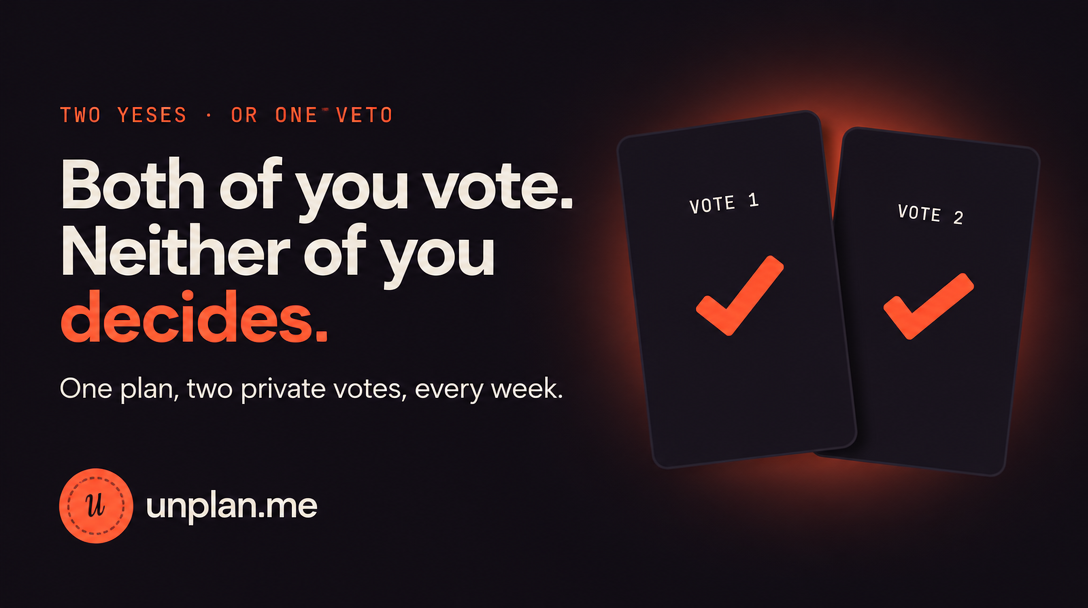
This is the change that does the most work, and it's the one most couples never try. Instead of one person proposing and the other agreeing, both of you answer the same question independently, without knowing the other's answer.
Two benefits, immediately. Nobody has to overrule their partner to their face, so the honest answer actually gets said. And neither person can make the other the reason they never go anywhere.
It works on any scale. Try it with a weekend, with a big purchase, with where to eat on Saturday.
Take turns without keeping score #
Alternating who plans is the obvious fix and it usually fails within three weeks, because the non-planner never learns what good looks like. A better version: both people do the easy part, and a system does the hard part.
That's what unplan is for. You each set your own side of the guardrails once — home base and distance, budget, how you get around, what you won't eat or drink, which nights you're free. Shared interests lean the plans the right way. Then neither of you is the planner.
By default, every Thursday at 6 PM a sealed card arrives on both phones: a one-line mood and four clues, never the place. You each tap accept or veto without seeing the other's vote. Voting closes Friday at 6 PM. Two yeses and it opens — stops, times, directions, invites in both calendars. One veto brings one alternative built for the same night; veto that too and you have a free at-home plan. There's never a third card.
And it stays private forever: your partner can see that you voted, never how. They can see the shared guardrails and who changed them, the plan once you've both said yes, and the journal photo. They can't see how you voted, how you rated the night, or your notification settings.
One plan a week. Two blind votes. One subscription covers both of you.
Set up your first Thursday — free to start, works in the browser, and pairing up takes about two minutes.
FAQ #
How do you divide planning fairly as a couple? #
Make the work visible and split it by decision, not by week. Agree the standing night, budget and limits once, then give each other a private vote on each proposal so both people genuinely shape the plan.
What if my partner never plans anything? #
Usually they don't know what the good options are, so proposing feels like a risk. Give them a bounded choice instead of an open one — accept or veto one concrete plan — and the contribution becomes possible.
Should partners vote on things separately? #
For plans and preferences, private votes work better than open debate: nobody has to argue, and both answers are honest. For anything with real consequences, talk it through — a blind vote is for choosing a night, not for choosing a house.
Does one person always have to be the organiser? #
No, and it's worth changing precisely because it's usually the same person. If the organising is shared, the plans stay varied and neither partner ends up feeling like a guest.